PROTEGO® 10% Technology:
At What Pressure Does the Relief Valve Open?
Engineering Safety Through Precision
Pressure and vacuum Dépression Vacuum is the pressure in an enclosed space that is lower than the ambient pressure. relief valves are essential safety components in pressurized storage tank systems, particularly in industries that handle flammable gases or volatile liquids.
The exact set pressure Pression de réponse Set pressure is the gauge pressure at the device inlet at which the relief device is set to start opening under service conditions. at which a relief valve opens is more than just a technical parameter; it also affects operational safety and compliance. PROTEGO® uses its 10% technology to revolutionize this critical threshold, offering unrivaled precision protection. This article delves into how PROTEGO®'s approach improves both plant safety and process efficiency.
What is the Relief Valve Set Pressure?
The set pressure Pression de réponse Set pressure is the gauge pressure at the device inlet at which the relief device is set to start opening under service conditions. of a relief valve is the calibrated pressure at which it starts to open in order to relieve excess internal pressure or vacuum Dépression Vacuum is the pressure in an enclosed space that is lower than the ambient pressure. in the system. To ensure safe, dependable, and code-compliant performance, it must be precisely calibrated in relation to the tank maximum allowable working pressure and vacuum (MAWP/V), specified design pressure Pression de conception Design pressure is the maximum pressure for which the system or component was designed for continuous usage. /vacuum, operating pressure Pression de service Operating pressure is the pressure existing at normal operating conditions within the system being protected. /vacuum, and system dynamics.
PROTEGO® 10% Technology:
A Higher Standard
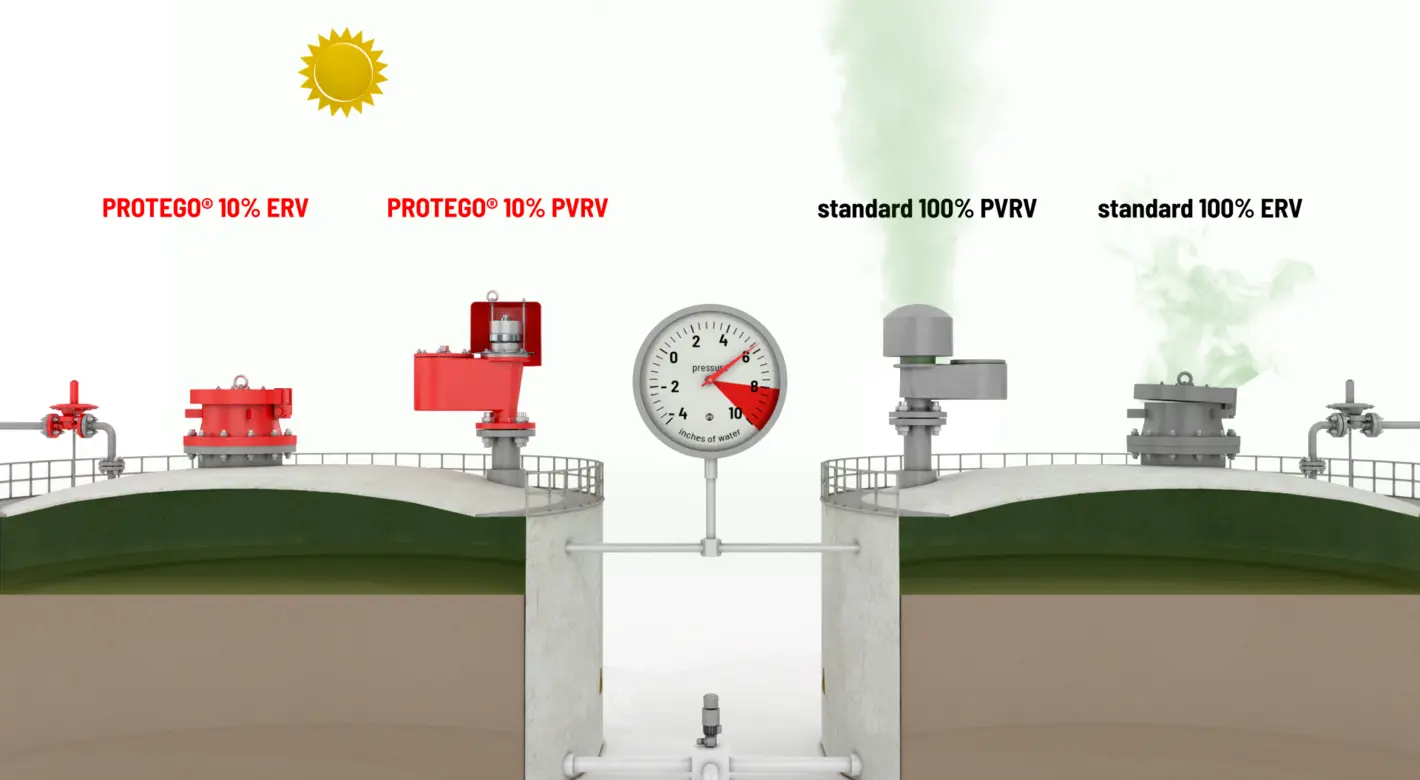
PROTEGO® has developed a line of relief valves, that open reliably at 10% overpressure Surpression Overpressure refers to an increase in pressure in a system or vessel above the normal operating pressure. . This defines their ‘ 10% technology .’ Unlike many traditional valves, which may require 100% or 40% overpressure Surpression Overpressure refers to an increase in pressure in a system or vessel above the normal operating pressure. to function properly, PROTEGO® valves provide a setpoint with a higher pressure which therefor increases the available tank operating pressure Pression de service Operating pressure is the pressure existing at normal operating conditions within the system being protected. without increasing leakage and emissions as the PVRV remains closed for longer and relieving cycles are reduced.
Key Features of the PROTEGO® 10% Relief Valve Technology
- Tight Operating Band: Opens within 10% overpressure for precise venting
- Minimal Leakage: Enhances emission control and conserves product
- Durability and Repeatability: Designed for long-term performance under harsh operating conditions
- High Flow Capacity: Optimized valve design to allow for high flow capacity
Example: For a set pressure of 100 mbar, PROTEGO® Pressure and Vacuum Relief Valves Soupape de surpression et dépression A pressure and vacuum relief valve is a pressure equalization valve for impermissible pressure and vacuum in a closed system. will be fully open at 110 mbar. This feature is particularly important for storage tanks which have very low MAWP or MAWV available.
How PROTEGO® Achieves 10% Accuracy
- Precision Machining of Valve Components
PROTEGO® ensures superior valve seat Siège de soupape The valve seat is a component on which the valve pallet rests when the valve is closed. leakage tightness by meticulously machining and lapping the valve pallet Clapet Valve pallet is the generic term for the assembly that rests on the valve seat. and seat. Metal-to-metal seals achieve ultra-flat surfaces that eliminate leakage which is critical for maintaining tight operational tolerances. - Optimized Sealing Options
PROTEGO® uses specialized sealing technologies to meet a variety of pressure requirements. Metal-to-metal seals provide superior mechanical integrity and sealing reliability in higher-pressure environments. Meanwhile, FEP air cushion seals are used for lower-pressure applications where elasticity improves tightness without requiring more lift Course Lift is the actual travel of the valve pallet from the main valve out of the closed position. pressure. Exotic metals, composites and plastics are also available for more demanding applications such as corrosive or polymerizing vapors. These optimized seal Joint A seal prevents or limits unwanted transfer of product from one container to another. Seal is used as superordinate term for all types of sealing elements. configurations consistently surpass the stringent leak-tightness benchmarks established by standards such as API 2000 and EN ISO 28300. - Flow-Enhancing Valve Design
The internal configuration of PROTEGO® valves includes a flow-enhancing design that improves efficicieny during operation. This streamlined geometry enables a quick transition to full valve lift Levée de soupape Actual travel of the valve pallet away from the closed position when a valve is relieving. , resulting in smooth and consistent fluid flow. Utilizing their Flow Test facility, PROTEGO’s approach to flow optimization results in accurate valve sizing and stable flow during venting cycles. - Full-Lift Pallet Design
PROTEGO® uses full- lift Course Lift is the actual travel of the valve pallet from the main valve out of the closed position. pallets in its pressure and vacuum relief valves, which can reach full lift and maximum discharge capacity with just 10% accumulation. Unlike many conventional designs that may require as much as 100% overpressure to fully open, this innovative approach ensures rapid, stable, and predictable valve behaviour. The full-lift capability is a critical requirement to achieve over and under pressure relief whilst optimizing process efficiencies and tank emission reduction targets.
Why It Matters
Understanding the pressure at which a relief valve opens is more than just an academic exercise; it is an essential component of plant safety and emissions control.
The PROTEGO® 10% Relief Valve Technology ensures that your system vents at the appropriate time, protecting people, the environment and your equipment.