Features
Function and Description
Highly Developed Vacuum Relief Valve
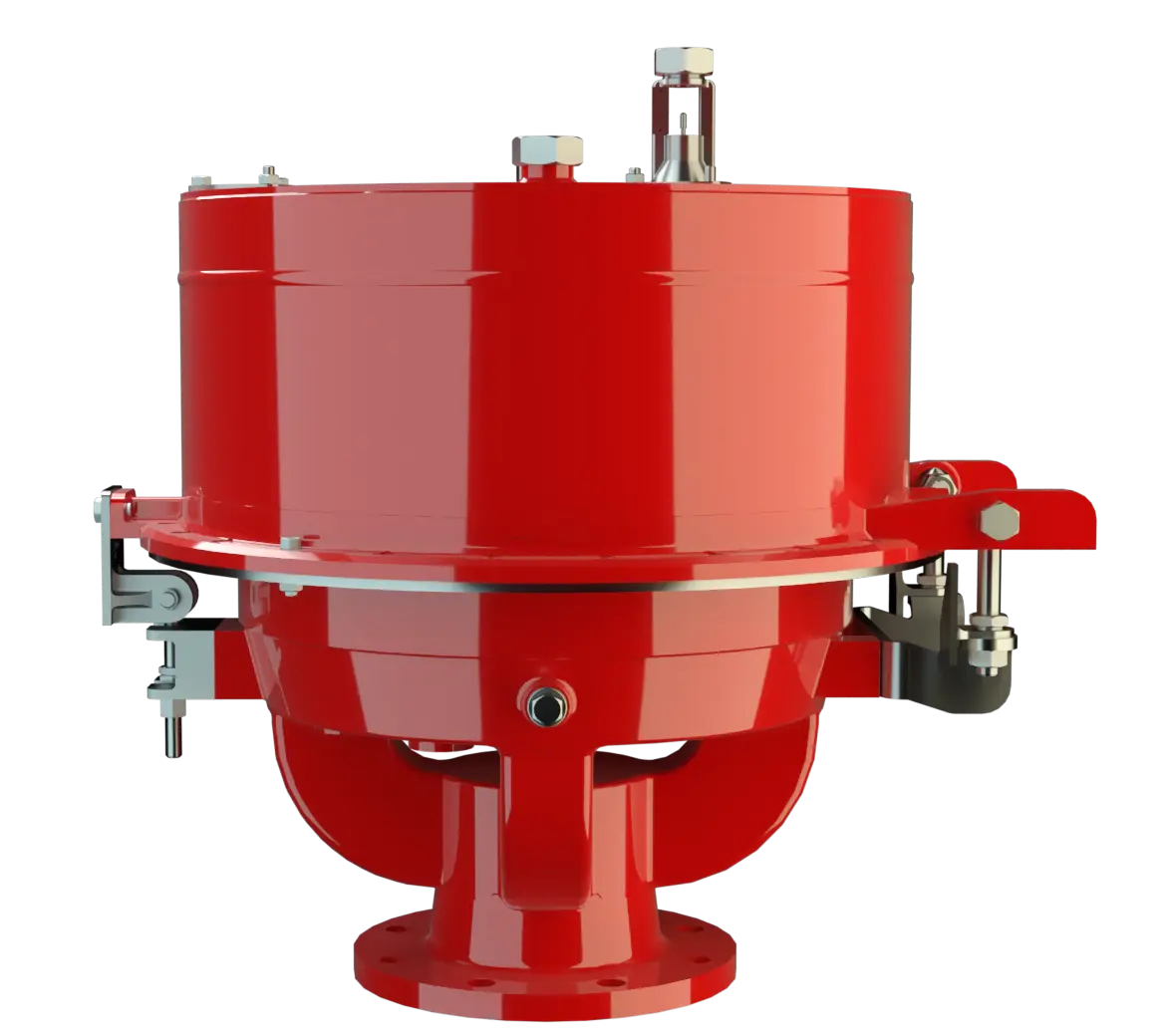
The PROTEGO® UB/VF diaphragm Diaphragm A diaphragm is a thin layer of material, which has a large surface area. valve is a worldwide unique vacuum relief valve Vacuum relief valve A vacuum relief valve is used to ventilate a part of the system and protects it from impermissible underpressure. combining the function of a dynamic and static Flame Arrester Flame arrester Device fitted to the opening of an enclosure, or to the connecting pipe work of a system of enclosures, and whose intended function is to allow flow but prevent the transmission of a flame. . It is primarily used as a device Device A device is a pipe component that influences the media flow by opening, closing, or partially shutting off the flow channel or by dividing or mixing the media flow. for flame transmission-proof Flame transmission-proof Characteristic of a device to avoid flashback. in-breathing on tanks, containers, and process equipment Equipment Machines, appliances, fixed or mobile devices, control parts and accessories, and warning and prevention systems, whether separate or combined, intended for the generation, transfer, storage, measurement, control, and conversion of energy, and for the processing of materials, which have their own potential source of ignition and may cause an explosion. . The valve offers reliable protection against vacuum Vacuum Vacuum is the pressure in an enclosed space that is lower than the ambient pressure. build up, prevents the in-breathing of air and product Product Includes equipment, protective systems, devices, components and combinations of these. losses almost up to the set vacuum Set vacuum Internal negative gauge pressure at which a vacuum valve first opens. , and protects against atmospheric deflagration Deflagration Explosion propagating at subsonic velocity. .

High Operational Reliability in Extreme Conditions
The PROTEGO® UB/VF diaphragm valve has proven itself over many years under a wide variety of operating conditions in the mineral oil and chemical industries. Worldwide, it is the only vent which works reliably with problem products such as styrene or acrylates. The set vacuum is adjusted with a freeze resistant water-glycol mixture which ensures safe operation under extreme cold weather conditions. The PROTEGO® UB/VF valve is available for substances from explosion Explosion Abrupt oxidation or decomposition reaction producing an increase in temperature, pressure, or in both simultaneously. group IIB3.
Composition
If a vacuum builds up in the tank, it is transmitted through pressure Pressure (gauge pressure) Pressure for which the value is equal to the algebraic difference between the absolute pressure and the atmospheric pressure. balancing tubes into the vacuum chambers (1), (2), which are connected to each other. This will remove the weight of the load liquid, and the atmospheric pressure will lift Lift Lift is the actual travel of the valve pallet from the main valve out of the closed position. the diaphragm (3) off the inner and outer valve seat Valve seat The valve seat is a component on which the valve pallet rests when the valve is closed. rings (4, 5), resulting in ventilation of the tank. The vacuum setting is adjusted via the filling level of the load liquid and can be checked by a floating level indicator (6).
Advanced Manufacturing Technology
The tank vacuum is maintained up to the set vacuum with a tightness that is above the normal standards due to our highly developed manufacturing technology. This is achieved by the liquid loaded diaphragm pressing tightly around the special designed valve seat surface area even when the operating vacuum increases, which reduces surface pressure and unnecessary leakage. After the vacuum is balanced, the valve re-seats and provides a tight seal Seal A seal prevents or limits unwanted transfer of product from one container to another. Seal is used as superordinate term for all types of sealing elements. .
Main Component – PROTEGO® Flame Arrester Unit
At very low vacuum settings, the explosion Explosion Abrupt oxidation or decomposition reaction producing an increase in temperature, pressure, or in both simultaneously. pressures resulting from an atmospheric deflagration may be strong enough to lift the diaphragm off the valve seat rings. The ignition into the tank can be prevented by installing the PROTEGO® Flame Arrester Unit PROTEGO® flame arrester unit The PROTEGO® flame arrester unit is the main component of a flame arrester. It prevents flame propagation. (7). This PROTEGO® Flame Arrester Unit provides additional protection against atmospheric deflagration when the valve is open for maintenance Maintenance Combination of all technical and administrative actions, including supervision actions, intended to maintain or restore a unit in working order. and inspection. The valve can be used at an operating temperature Operating temperature Temperature reached when the equipment is operating under design conditions. of up to +60°C/ 140°F and meets the requirements of European Tank Design Standard EN 14015 (Appendix L) and ISO 28300 (API 2000). EU conformity according to the currently valid ATEX directive. Approvals according to other national/international regulations on request.
Dimensions
To select the nominal size Nominal size The nominal size is an alphanumeric designation of size for components in a piping system, used for reference purposes, comprising the letters DN followed by a dimensionless integer that is indirectly related to the physical size of the bore or outside diameter of the connections, expessed in millimeters. (DN), please use the flow capacity charts on the following pages
| DN | vacuum | vacuum | 80 / 3" | vacuum | vacuum | 100 / 4" | 150 / 6" |
| a | up to -28 mbar | up to -11.2 inch W.C. | 615 / 24.21 | up to -22 mbar | up to -8.8 inch W.C. | 645 / 25.39 | 680 / 26.77 |
| a | < -28 mbar | < -11.2 inch W.C. | 765 / 31.12 | < -22 mbar | < -8.8 inch W.C. | 795 / 31.30 | 830 / 32.68 |
| b | 410 / 16.14 | 485 / 19.09 | 590 / 23.23 |
Dimensions in mm / inches
Material selection for housing
| Design | C | D |
| Housing Housing A housing is a solid shell, which surrounds a content, either protecting the content from external influences, or protecting the environment from the content. | Cast Iron | Stainless Steel |
| Valve top | Stainless Steel | Stainless Steel |
| Heating coil (UB / VF-H-...) | Stainless Steel | Stainless Steel |
| Valve seat | Stainless Steel | Stainless Steel |
| Gasket | FPM | PTFE |
| Diaphragm | A, B | A, B |
| Flame arrester unit Flame arrester unit Flame arrester casing with FLAMEFILTER® set. | A | C |
Option: Housing with ECTFE- lining Lining Protective plastic lining with a defined minimum/maximum thickness to protect against aggressive mixtures (e.g., acid).
Special materials upon request
Material selection
| Design | A | B |
| Diaphragm | FPM | FEP |
Special materials upon request
Material combinations of flame arrester unit
| Design | C |
| FLAMEFILTER® cage | Stainless Steel |
| FLAMEFILTER® | Stainless Steel |
| Spacer Spacer The spacer is a component that is generally used in a PROTEGO® flame arrester as a spacer within the FLAMEFILTER® set. | Stainless Steel |
Special materials upon request
Selection of explosion group
| MESG | Expl. Gr. (IEC / CEN) | Gas Group (NEC) |
| ≥ 0,65 mm | IIB3 | C |
Special approvals upon request
Flange connection type
| EN 1092-1; Form B1 |
| ASME B16.5 CL 150 R.F. |
other types upon request
Design Types and Specifications
The diaphragm is pressurized by liquid.In addition to the standard design, a series of specially developed designs, which are particularly suitable for operating conditions to which these products are subjected, can be provided upon request (for example, for acrylics or styrene storage tanks, etc.).
Settings
| Vacuum: | -3.5 mbar | -35 mbar |
| -1.4 inch W.C. | -14 inch W.C. |
Higher vacuum settings upon request
Flow Capacity Chart
UB/VF DN80 Pressure
UB/VF DN100 Vacuum
UB/VF DN150 Vacuum
The flow capacity charts have been determined with a calibrated and TÜV certified flow capacity test rig. Volume flow V in (m³/h) and CFH refer to the standard reference conditions of air ISO 6358 (20°C, 1bar). For conversion to other densities and temperatures refer to Sec. 1: “Technical Fundamentals”.