BE/HR-E-IIB
Deflagration Flame Arrester, endurance burning proof, End-of-Line
Características
Função e descrição
Protection Against Atmospheric Deflagration and Endurance Burning
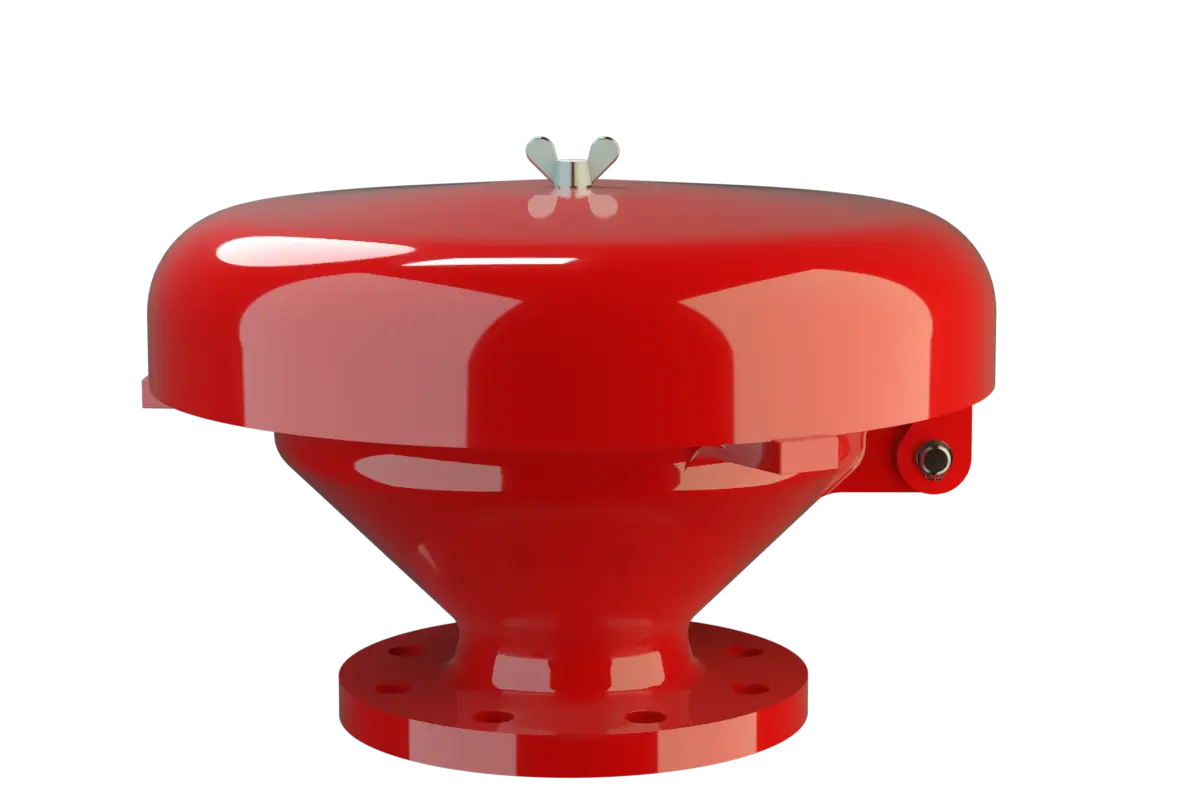
The PROTEGO® BE/HR-E End-of-Line Deflagration Flame Arrester Deflagration flame arrester Flame arrester designed to prevent the transmission of a deflagration. It can be an end-of-line flame arrester or an in-line flame arrester. has been specifically designed for the protection of non-pressurized systems and containers. The device Device A device is a pipe component that influences the media flow by opening, closing, or partially shutting off the flow channel or by dividing or mixing the media flow. is preferably installed on venting and breathing lines of non-pressurized systems and containers as well as on sea and inland tank vessels and thus prevents the entry of fire or atmospheric deflagration Deflagration Explosion propagating at subsonic velocity. . The specific process of combustion reactions during stabilized burning Stabilized burning Steady burning of a flame stabilized at, or close to the flame arrester element. of alcohols necessitates a constructively adapted flame arrester Flame arrester Device fitted to the opening of an enclosure, or to the connecting pipe work of a system of enclosures, and whose intended function is to allow flow but prevent the transmission of a flame. . The equipment Equipment Machines, appliances, fixed or mobile devices, control parts and accessories, and warning and prevention systems, whether separate or combined, intended for the generation, transfer, storage, measurement, control, and conversion of energy, and for the processing of materials, which have their own potential source of ignition and may cause an explosion. provides safety against atmospheric deflagrations and endurance burning Endurance burning Stabilized burning for an unlimited time.

Main Component – PROTEGO® Flame Arrester Unit
The PROTEGO® BE/HR-E-IIB consists of a housing Housing A housing is a solid shell, which surrounds a content, either protecting the content from external influences, or protecting the environment from the content. (1), a weather hood Weather hood A weather hood is a cover to protect the internal components of a device from environmental influences. (2) and the PROTEGO® Flame Arrester Unit PROTEGO® flame arrester unit The PROTEGO® flame arrester unit is the main component of a flame arrester. It prevents flame propagation. (3). During normal operation, the metal weather hood is in a closed position. If a flame burns on the Flame Arrester Element surface, the fusible link (5), located in a center position, will melt and let the spring Spring A spring is a spiral of wire which returns to its original shape after it is pressed or pulled. -loaded weather hood move into the open position. The PROTEGO® Flame Arrester Unit consists of two FLAMEFILTER® discs (4), which are installed in a FLAMEFILTER® casing FLAMEFILTER® cage The FLAMEFILTER® cage is a housing for a FLAMEFILTER® set. .

For Explosion Group IIB
The PROTEGO® BE/HR-E End-of-Line Deflagration Flame Arrester is available for hydrocarbons for explosion Explosion Abrupt oxidation or decomposition reaction producing an increase in temperature, pressure, or in both simultaneously. group IIB (MESG ≥ 0,5 mm) and alcohols. The standard design can be used for operating temperatures up to +60°C / 140°F. EU conformity according to the currently valid ATEX directive. Approvals according to other national/international regulations on request. Approved according to IMO MSC/Circular 677 as well as IMO MSC.1/Circular 1324 and 1325.
Tabela de dimensões
To select the nominal size Nominal size The nominal size is an alphanumeric designation of size for components in a piping system, used for reference purposes, comprising the letters DN followed by a dimensionless integer that is indirectly related to the physical size of the bore or outside diameter of the connections, expessed in millimeters. (DN), please use the flow capacity charts on the following pages
| DN | 80 / 3" | 100 / 4" |
| a | 353 / 13.90 | 353 / 13.90 |
| b | 250 / 9.84 | 250 / 9.84 |
Dimensões em mm
Dimensions for Deflagration flame arrester with heating jacket upon request
Seleção do material do corpo
| Design | B | C |
| Housing | Steel | Stainless Steel |
| Weather Hood | Steel | Stainless Steel |
| Flame arrester unit Flame arrester unit Flame arrester casing with FLAMEFILTER® set. | A | A, C |
Special materials upon request
Combinações de material do conjunto abafador de chamas
| Design | A | C |
| FLAMEFILTER® cage | Stainless Steel | Stainless Steel |
| FLAMEFILTER® | Stainless Steel | Hastelloy |
| Spacer Spacer The spacer is a component that is generally used in a PROTEGO® flame arrester as a spacer within the FLAMEFILTER® set. | Stainless Steel | Hatelloy |
Special materials upon request
Seleção do grupo de explosão
| MESG | Expl. Gr. (IEC / CEN) | Gas Group (NEC) |
| ≥ 0,5 mm | IIB | B |
Special approvals upon request
Tipo de conexão flangeada
| EN 1092-1; Form B1 |
| ASME B16.5 CL 150 R.F. |
other connections upon request
Diagrama de vazão
Este diagrama de vazão foi determinado em uma bancada de medição de vazão calibrada e certificada pela TÜV. A vazão V em m³/h se refere ao estado técnico padrão de ar, conforme ISO 6358 (20°C, 1bar). Para conversão em outras densidades e temperaturas, veja o cap. 1: Bases técnicas.